

How to Calculate Grades From Rubric Scores
Grading with a rubric doesn’t have to be confusing. If you have a list of criteria and each one has a score, you can turn that into a clear grade fast. Quick Grade
In this article, I’ll explain step by step how rubrics work, how to calculate grades from rubric scores, and share tips so you get it right every time.
Rubrics are used in schools and colleges to make grading fair and consistent. A rubric breaks down an assignment into parts, and each part gets a score. Once you know how to turn all those scores into a final grade, you save time and stress.
What Is a Rubric?
A rubric is a scoring guide teachers use to evaluate student work. It lists the criteria (things you’re grading) and levels (how well the work meets each criterion). For example, “Excellent,” “Good,” “Fair,” and “Needs Improvement” might have points attached.
Rubric scores are not random. Each level has a number tied to it, so you can compute a final grade based on the performance across all criteria.
Step‑by‑Step: Calculating Grades From Rubric Scores
Here’s how most rubric grading systems work in a simple way:
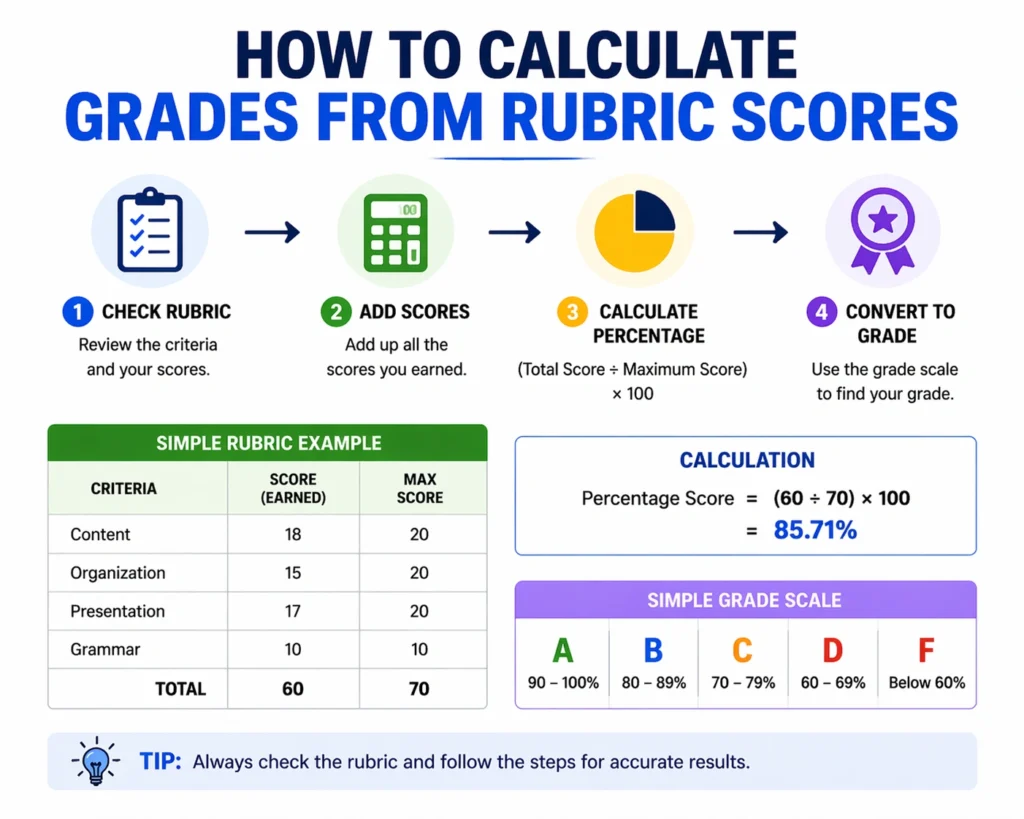
1. Add Up All the Rubric Points
Start by adding the points a student earned for each criterion. If there are four criteria and the student scored 3, 4, 3, and 4, then:
Actual points = 3 + 4 + 3 + 4
This gives the raw score the student earned.You can also read:How to Handle Zeros in Grade Calculations 2026
2. Find the Maximum Possible Points
Figure out what the highest possible score could have been. If each criterion is worth up to 4 points, and there are four criteria:
Maximum points = 4 + 4 + 4 + 4
This gives the most points someone could earn.
3. Convert to a Percentage
To turn the raw score into a grade you can understand easily, convert it to a percentage:
Percentage score = (Actual points / Maximum points) × 100
This gives you a number that is easy to compare, like 85% or 92%.
For example, if the student got 14 out of 16:
Percentage score = (14 ÷ 16) × 100 = 87.5%
This percentage is useful because many schools convert percentages into letter grades or standards.
4. Convert Percentage to a Final Grade
Once you have a percentage, you can use your school’s grading scale to turn that into a letter grade or other format your class uses, like A, B, C, or a narrative report.
This method works whether you use simple point rubrics or weight different criteria differently. The idea is always the same: compare what was earned with what was possible to get a fair result.
A Quick Alternative: Rubric Percentage Method
Some teachers use a slightly different way of thinking about rubrics:
Instead of adding points, they look at how well each criterion was met and assign a percentage for each level (like 90% for “Excellent,” 75% for “Good,” etc.). Then they average those percentages across all criteria.
Either way—straight point sum or percentage levels—the goal is to turn rubric performance into a number that reflects how well the student did.
Tips to Make This Even Easier
- If you use Excel or Google Sheets, put criteria and points in columns and let the sheet do the math for you.
- Always double‑check that the highest rubric score matches the total maximum points before converting to percentages.
- Explain the rubric to students before they start their work so they understand how they’ll be graded. It makes scoring feel fairer.
Common Mistakes to Avoid
- Forgetting to count the lowest possible score when you set up a rubric — this can skew your percentages.
- Not checking whether all criteria have the same point values.
- Assuming the rubric automatically converts to a grade without doing the math first.
Frequently Asked Questions
1. What if my rubric has different points for different criteria?
That’s ok. First calculate how many points someone could possibly get, then add what the student received, and make your percentage based on that total.
2. Can rubric grades be converted into letter grades?
Yes. Once you have a percentage, you can map it to your letter grade scale, like A = 90–100, B = 80–89, and so on.
3. Does weighting matter?
If some criteria are more important than others, assign them more points before you calculate totals. Just be consistent.
4. Do all schools use the same rubric calculation?
Not always. Some educators calculate differently, but the basics are the same: total earned over total possible.
5. Can I use rubrics for non‑academic scoring?
Yes. Rubrics are useful for any situation where you want clear criteria and consistent scoring, from performance reviews to project evaluations.
Final Thoughts
Calculating grades from rubric scores is really about thinking clearly and doing simple math. Once you know how to add up earned points, work out the maximum possible, and convert to a percentage, you have a fair and transparent grade.


