

How to Convert a 4 Point Scale to Percent QuickGrade
If you want the quick answer, the most common shortcut is:
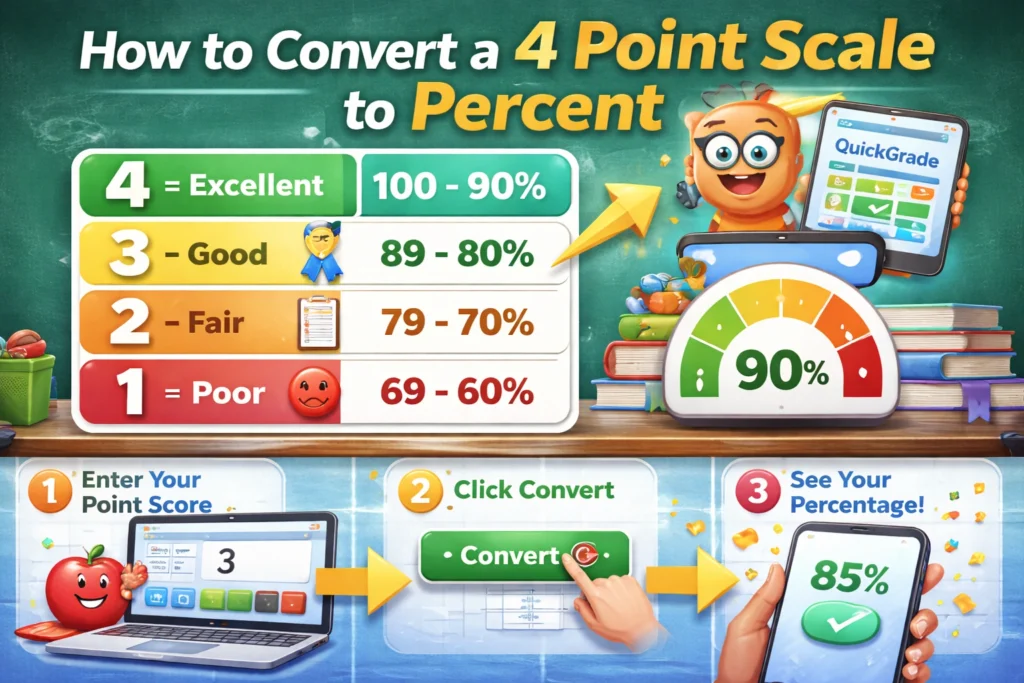
Percentage = GPA × 25
So if your GPA is 3.2 on a 4.0 scale, your estimated percentage is:
3.2 × 25 = 80%
That works because a 4.0 scale treats 4.0 as the top score, so multiplying by 25 turns it into a number out of 100. Many conversion tools and guides use this as the standard quick method for a 4-point scale.Quick Grade
But here is the important part: this is only an estimate. Some schools, colleges, and evaluation services use their own grade cutoffs, plus/minus rules, or country-based conversion systems. That means your official percentage may be a little different. BigFuture says schools use different grading scales, and Iowa State’s calculator even asks for the lowest “A” percentage before converting, which shows that conversion depends on school rules. WES also says GPA comparisons are based on the most common grading scales for the country of education.

The simple formula
Use this:
Percentage = (GPA ÷ 4.0) × 100
This is the same as:
Percentage = GPA × 25
Both formulas give the same answer.
Example 1
GPA = 4.0
4.0 × 25 = 100%
Example 2
GPA = 3.8
3.8 × 25 = 95%
Example 3
GPA = 3.5
3.5 × 25 = 87.5%
Example 4
GPA = 3.0
3.0 × 25 = 75%
Example 5
GPA = 2.7
2.7 × 25 = 67.5%
Quick 4 point scale to percent chart
Here is a simple reference chart based on the common formula:
- 4.0 = 100%
- 3.9 = 97.5%
- 3.8 = 95%
- 3.7 = 92.5%
- 3.6 = 90%
- 3.5 = 87.5%
- 3.3 = 82.5%
- 3.0 = 75%
- 2.7 = 67.5%
- 2.5 = 62.5%
- 2.0 = 50%
- 1.0 = 25%
This chart is useful for a quick estimate, but it should not replace your school’s official conversion method.You can also read: Grade Calculator for Parents and Homeschoolers
Why the result is not always exact
This is where many competitor pages are weak. They give the formula, but they do not clearly explain that grading systems are not universal.
For example, BigFuture uses one common system where A = 90–100 = 4.0, B = 80–89 = 3.0, C = 70–79 = 2.0, and D = 66–69 = 1.0, but it also says this is not necessarily the true formula for every school. Chowan University uses a more detailed chart with plus/minus-style ranges, where 90–92 = 3.7, 87–89 = 3.3, 83–86 = 3.0, and so on. That means the same percentage can be treated differently depending on the school.
So, if you only need a fast answer for a blog post, profile, or rough estimate, GPA × 25 is fine. But if you need the number for college admission, credential evaluation, scholarships, or official paperwork, use your school’s own conversion chart or ask the admissions office.
The more accurate way to convert a 4 point scale to percent
If you want the most accurate result, do this:
1. Check your school’s grading policy
Look for a chart that shows how letter grades, GPA points, and percentages match up. Some schools use plain letters only. Others use plus and minus grades too.
2. See where your GPA falls
If your school says a B+ = 3.3 and B+ = 87–89%, then a 3.3 GPA may match that range better than a flat formula would. Chowan and other GPA chart pages use this kind of mapping.
3. Use the exact range, not just one number
A GPA of 4.0 does not always mean exactly 100%. On some charts, 4.0 can cover a whole range, like 93–100 or 97–100, depending on the system.
Formula method vs chart method
The formula method is best when you want a quick estimate.
Example:
3.4 GPA × 25 = 85%
The chart method is better when your school has an official grading table.
Example:
On one common chart, a B = 83–86% = 3.0 and a B+ = 87–89% = 3.3. On another school’s system, the ranges may be slightly different.
If your school uses weighted GPA
Be careful here. A weighted GPA is not the same as a standard 4.0 GPA. Some schools give extra points for AP, IB, or honors classes. BigFuture notes that some schools use weighted GPA systems, and colleges may even recalculate GPAs in their own way. So do not use GPA × 25 on a weighted GPA unless you are sure the GPA has already been converted back to a standard 4.0 scale.
Common mistakes to avoid
The biggest mistake is assuming that every school uses the same grading scale. They do not. BigFuture says schools may calculate GPA differently, and Iowa State’s tool shows this by asking for the lowest “A” when converting from percentages.
Another common mistake is converting a weighted GPA like 4.3 or 4.5 as if it were on a standard 4.0 scale. That gives the wrong percentage unless you first know the original scale and rules.
A third mistake is using an online calculator without checking whether it matches your school, board, or country. WES says its GPA comparisons are based on the most common grading scales for the country of education, which is another reminder that context matters.
Best quick answer for most readers
If someone asks, “How do I convert a 4 point scale to percent?” the easiest answer is:
Multiply your GPA by 25.
That gives you a fast estimate.
Examples:
- 4.0 = 100%
- 3.6 = 90%
- 3.2 = 80%
- 2.8 = 70%
- 2.4 = 60%
Then add this note:
Check your school’s official conversion chart if you need an exact result.
FAQ section
How do you convert a 4 point GPA to percentage?
Use this formula:
Percentage = (GPA ÷ 4) × 100
A simpler version is:
Percentage = GPA × 25
Is 3.5 GPA equal to 87.5%?
Using the common formula, yes:
3.5 × 25 = 87.5%
But your school may use a different chart for official conversion.
Is a 4.0 GPA always 100%?
Not always in official school records. A 4.0 is the top GPA on a standard scale, but some grading charts treat it as a range rather than one exact percentage.
Can I use GPA × 25 for college applications?
Only as a rough estimate. For official use, check your college, school, or credential evaluator’s conversion method.
Why do different websites show different answers?
Because grading systems vary by school, country, and whether the GPA is weighted or unweighted
Final thoughts
Converting a 4 point scale to percent is easy when you only need a rough answer. Just multiply by 25. But for official use, always check your school, university, or evaluation service because cutoffs and grading rules can change the result. That makes your article more useful than many competitor pages, because it gives both the fast formula and the real-world warning readers actually need


