

Grade Calculator for Curved Test Scores
Trying to figure out your grade after a curved test can feel confusing. Maybe you’ve heard your score “went up,” but you’re not sure how much or why.Quick Grade In this guide, I’ll explain how curved grades work, how to calculate them, and how to use a grade calculator so you know exactly where you stand. You’ll also get tips to make this easy every time you face a curved test.
What Is Curving a Grade?
Curving a grade means adjusting test scores so they reflect the overall performance of the class. Instead of using the raw score you earned, a curved score can raise or reshape your grade based on how everyone else did. This is done when an exam turns out harder than expected or the teacher wants to spread scores more fairly.
Think of it like tuning results so they make more sense — your performance isn’t judged alone, but in context with the entire group.
Common Ways Grades Are Curved
There are a few popular ways to curve grades. Knowing which method your teacher uses will help you calculate your curved score easily.
1. Flat Point Increase
This is the simplest method. Everyone gets the same number of extra points added to their raw score. For example, if your score was 75 and the teacher adds 5 points to everyone, your curved score is 80.
2. Highest Score Method
In this method, the highest score in the class becomes the new 100. Every other score scales up relative to that top score. For example, if the highest raw score was 88 and you scored 70, then your curved score becomes something like 80 after scaling.
3. Square Root or Other Mathematical Curves
Some teachers use formulas like a square root curve, which boosts lower grades more than high ones. Here the curved grade is calculated using a formula (like taking the square root of your raw percentage and multiplying by a number). This helps students who struggled more without giving too much extra to those already near the top.You can also read: How to Grade Tests With Bonus Questions
How to Use a Grade Calculator for Curved Scores
Grade calculators make this process much easier. You simply enter your raw score and choose a curve method. The calculator then shows your new curved grade, whether it’s a flat point adjustment, highest score scaling, or a more complex method.
Step‑by‑step:
Some tools even let you upload a list of grades and see how the whole class looks after curving.
Simple Example You Can Do by Hand
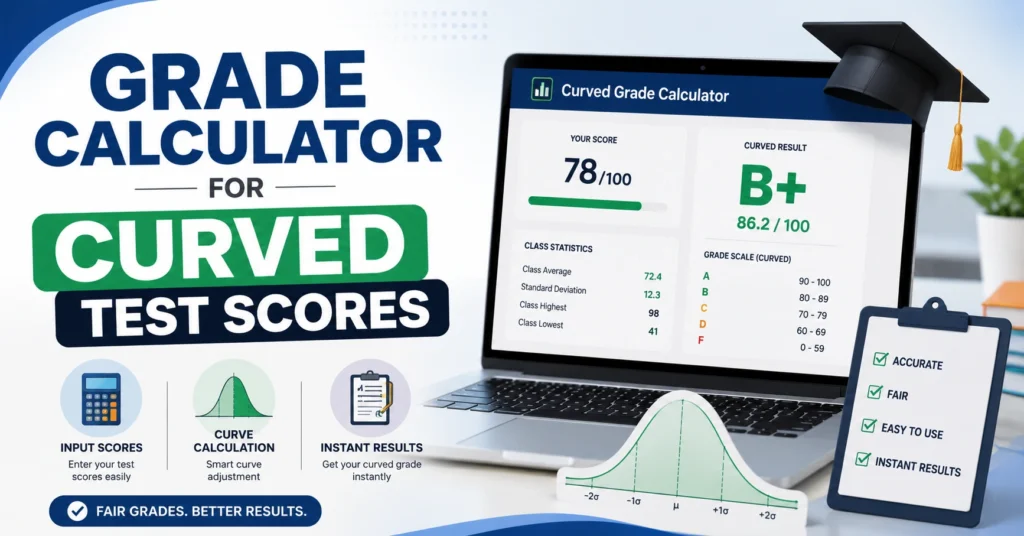
Let’s say:
Using the Highest Score method, you can calculate a curved grade like this:
Curved Score = (Your Score ÷ Highest Score) × 100
So if you divide 72 by 90, you get 0.8, and then multiply by 100, your curved score becomes 80.
This method keeps scores proportional while making the highest performer hit 100.
Why Curved Grades Can Be Useful
A curve helps when a test was unexpectedly tough or when the average score is lower than expected. It can lift everyone’s score up so the results reflect the real understanding of the material, not just one difficult test.
Teachers often use curves to make grades fairer across different classes or sections.
FAQs
1. What does “grading on a curve” really mean?
It means adjusting raw test scores based on class performance so grades fit a more balanced scale rather than strict percentages.
2. Does a curved grade always mean your score goes up?
Not always, but most curves are designed to help students when tests are difficult. The exact change depends on the method used.
3. Can curved grades push your score above 100?
Some methods let top performers reach or stay at 100, but most tools cap maximum grades at 100 for fairness.
4. Is it fair to use a curve for every test?
Curves are best used sparingly or when a test was unexpectedly hard. Overusing them can dilute the value of grades.
5. Can you calculate curved grades on your own without a tool?
Yes. If you know the curve method and the highest score or amount to add, you can use simple math to find your curved grade.
Final Words
Understanding how curved test scores work helps you know where you stand in class and shows you how grades are adjusted fairly. Using a grade calculator takes all the guesswork out of the math and gives you a clear result in seconds. Whether you’re a student checking your score or a teacher reviewing a class, this approach keeps grading simple, fair, and easy to understand.


