

Grade Calculator for International Grade Scales: 2026
As the world becomes more interconnected, students and educational institutions often need to deal with different grading systems. Whether you’re studying abroad, Quick Grade applying for international universities, or managing an institution that deals with international students, understanding and calculating grades across different systems can be a challenge. That’s where a grade calculator for international grade scales comes in handy!
What Is a Grade Calculator for International Grade Scales?
A grade calculator for international grade scales is a tool that helps you convert and calculate grades from one grading system to another. Since grading systems vary by country, this tool makes it easier for students and educators to understand grades in different contexts. For example, a grade of “A” in the United States might correspond to a different numerical value or letter grade in Europe or Asia.
Why Do You Need a Grade Calculator?
- International Education: Many students today are applying for colleges and universities in different countries. When your grades are in one system, but the school uses another, a grade calculator helps convert your grades to fit the international scale.
- University Applications: Some universities require applicants from different countries to convert their grades to a common scale. A grade calculator ensures that your grades are understood in the proper context, so there are no surprises when your application is reviewed.
- Professional Opportunities: If you’re applying for jobs internationally, especially in companies that evaluate education credentials globally, understanding how your grades compare across systems can give you an edge.
- Fair Comparisons: If you’re comparing your grades with students from other countries, it can be hard to know how your performance stacks up. With a grade calculator, you can get an accurate comparison, giving you a better understanding of where you stand.
How Does a Grade Calculator Work?
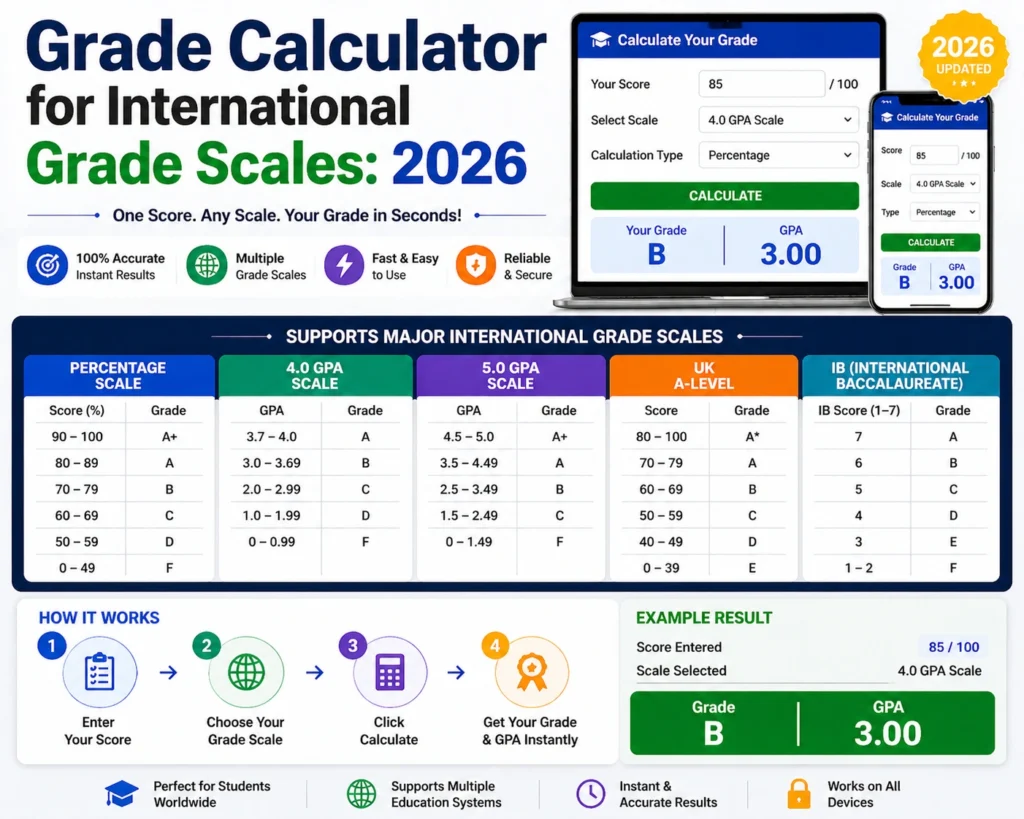
Grade calculators typically ask for your grade in your country’s system and then convert it to the target country’s scale. Here’s how it generally works:
- Input Your Grade: You enter your grade in the system it was awarded in. For example, a grade of “B+” in the UK system.
- Select the Target System: Choose the grading system you want to convert it to, such as the US GPA scale or the European ECTS scale.
- Get the Converted Grade: The calculator will then show you the equivalent grade in the selected system, helping you understand how your grade is perceived internationally.You can also read: Easy Grader for Math Tests with Half Points A Simple Solution
Popular International Grade Scales
Here are some common international grading systems:
- U.S. GPA Scale: Typically ranges from 0.0 to 4.0. An “A” is worth 4.0, a “B” is worth 3.0, and so on.
- European ECTS (European Credit Transfer and Accumulation System): This system uses grades from A (excellent) to F (fail). It’s often used by universities across Europe.
- UK Grading System: The UK system uses classifications like First Class (70% or above), Upper Second Class (60-69%), and Lower Second Class (50-59%).
- India CGPA (Cumulative Grade Point Average): The grading scale ranges from 0 to 10, with 10 being the best.
- Australia’s OP (Overall Position): The grading system uses a scale from 1 to 25, with 1 being the best.
- Canadian GPA: It’s similar to the U.S. GPA system, but some provinces have different methods of calculation.
Benefits of Using a Grade Calculator
1. Convenience: You don’t need to manually look up conversions or perform complex calculations. Just input your grade, and let the tool do the work.
2. Accuracy: With so many different grading systems worldwide, using a calculator ensures that your grades are converted accurately, without the risk of human error.
3. Time-Saving: When applying for international scholarships, universities, or jobs, a grade calculator speeds up the process of comparing and converting your grades.
4. Transparency: It gives you a better understanding of where your grades stand in a global context, allowing you to make more informed decisions about your academic or professional future.
How to Choose the Right Grade Calculator
- Check for Compatibility: Make sure the calculator supports the specific grading systems you need to work with. For example, some calculators may only cover the U.S. GPA and the UK grading system, while others may support a wide range of systems.
- Simple Interface: Look for a calculator that’s easy to use. A user-friendly interface will save you time and prevent confusion.
- Free vs. Paid Tools: Many grade calculators are available for free online, but some more advanced tools with additional features may require a subscription. Choose the one that fits your needs and budget.
Tips for Using a Grade Calculator
1. Double-Check Your Input: While calculators are great, it’s always a good idea to double-check your grades and the conversion scale. Some systems may have slight variations in how they interpret grades.
2. Understand the Limits: Keep in mind that while a grade calculator gives you a good estimate, there may be slight differences between how each institution or organization interprets grades. Always consult with the university or company if you’re unsure.
3. Use It as a Guideline: Use the calculator to get an approximate idea of how your grade compares, but remember that grade weightage, course difficulty, and the grading curve can also affect how your grades are evaluated.
FAQs
1. What is the most commonly used grading system internationally?
The most commonly used grading systems internationally are the U.S. GPA system and the European ECTS scale. Many universities worldwide use these systems, but countries like the UK, Canada, and Australia have their own grading systems, which may vary slightly in their interpretations.
2. Can a grade calculator be used for all types of courses?
Yes, a grade calculator can be used for all types of courses, whether you’re calculating grades for multiple-choice exams, essays, or project-based assessments. However, it works best for numeric grade conversions and may not account for subjective grading components like participation or class behavior.
3. Is the grade calculator accurate for all grading systems?
Grade calculators are generally accurate for standard systems like GPA and ECTS. However, there may be slight variations between how different institutions or countries interpret grades. It’s always a good idea to consult with your institution for specific grading policies.
4. Can I use a grade calculator for GPA conversion between countries?
Absolutely! Grade calculators are specifically designed to help you convert GPA and other grades between different countries’ systems. Just ensure that you’re using a calculator that supports the specific systems you’re dealing with, such as U.S. GPA, UK grading, or Indian CGPA.
5. Are there any free grade calculators available online?
Yes, there are many free grade calculators available online that support multiple international grading systems. These calculators are a great option for students who need to quickly convert their grades without spending money. However, for more advanced features or additional support, you may need to look at paid options.
Conclusion
Whether you’re applying for a university, seeking international work, or just trying to understand how your grades compare globally, a grade calculator for international grade scales is an essential tool. It simplifies the complex process of grade conversion, saving you time and ensuring that your academic performance is fairly represented on a global scale.


