

How to Convert Rubrics Into Percent Grades in 2026
If you’ve ever used a rubric to grade student work and wondered how to turn that into a percent grade, you’re not alone. Quick Grade, Converting rubric scores into a percent helps you put results into a gradebook, match letter grades, or compare performance fairly across assignments.
This guide will explain how rubric scores relate to percent grades, the right way to do the conversion, and some common tips teachers can use every day. I’ll keep it simple — like telling a friend how to do it.

What a Rubric Is
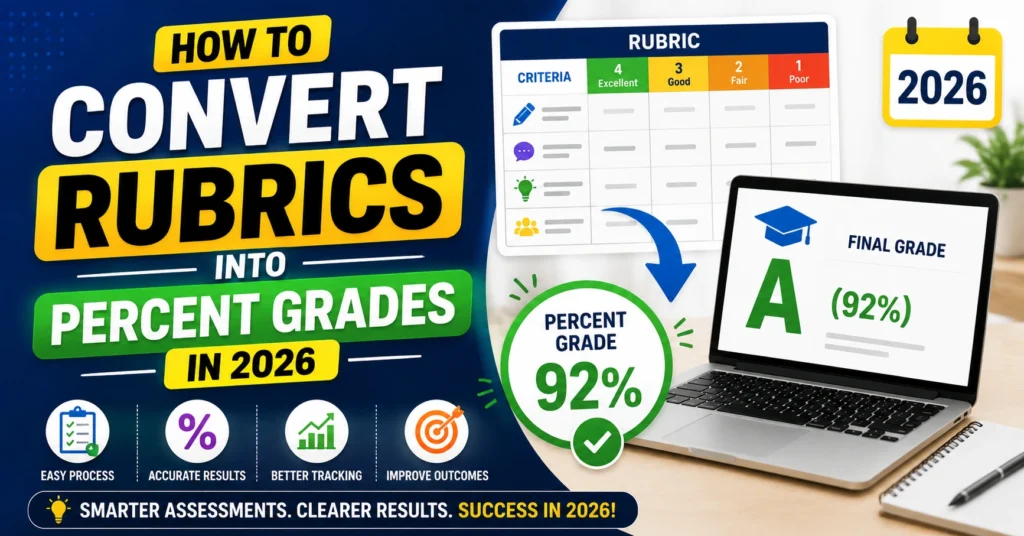
Before we convert anything, let’s clear one thing up: a rubric is a scoring tool that breaks down an assignment into criteria (like content, organization, accuracy) and performance levels (like excellent, proficient, developing). Each level represents how well a student met the criteria.
Some rubrics use points, others use percent ranges, and some are descriptive without points. To convert to a percent grade, you need a rubric that gives numerical values for performance levels.
Why Convert Rubric Scores to Percent Grades
Percent grades are familiar in gradebooks and easy to compare across assignments. They also fit standard grading scales where:
- 90–100% = A
- 80–89% = B
- 70–79% = C
…and so on.
Converting rubrics lets you take qualitative scores and turn them into numbers that can be averaged and tracked over time.
Step‑by‑Step: Convert Rubric Scores to Percent
Here’s a friendly, step‑by‑step way to do it:
1. Look at Your Rubric Structure
Check how many levels and criteria you have. For example, a common rubric might have:
- 4 Performance levels
- 4 Criteria
Each level might be worth a point value like 1–4 or a percentage range.You can also read: Grade Calculator for Google Classroom Teachers 2026
2. Decide on a Minimum and Maximum
Usually, the lowest rubric level should match your minimum passing percentage, and the highest level earns 100%. Many schools use 60–100% as the working range, but adjust this to your policy.
3. Convert the Raw Score
Instead of just adding rubric points and dividing by total points the wrong way, use a formula that maps the raw rubric score to the percent range.
A simple idea is:
Percent Grade = (Rubric Score earned − Minimum Score) ÷ (Max Score − Minimum Score) × (Max Percent − Min Percent) + Min Percent
For example, if your rubric has levels from 1–4 on four criteria:
- Lowest possible score = 4 (1 × 4)
- Highest possible score = 16 (4 × 4)
If a student scores 12, map that between the minimum and maximum, then convert to percent.
This method ensures the lowest rubric level gives you your chosen minimum percent, not zero.
Example Made Simple
Let’s say you have a 4‑level rubric with 4 criteria. A student earns:
- Level 4 on 2 items
- Level 3 on 1 item
- Level 2 on 1 item
Raw total = 4 + 4 + 3 + 2 = 13
Min score = 4 (all Level 1)
Max score = 16 (all Level 4)
Percent conversion:
- Subtract minimum: 13 − 4 = 9
- Divide by range: 9 ÷ 12 = 0.75
- Convert to percent: 0.75 × 100 = 75%
Now you can put that 75% into your gradebook.
Common Rubric to Percent Mistakes
Here are mistakes teachers often make and how to avoid them:
Adding rubric levels and dividing by total points is wrong. That treats the lowest possible as zero, which can unfairly lower passing performance.
Not defining a minimum percent. Your rubric should match your grading policy — some teachers use 60% as the lowest passing score. Decide that up front.
Not normalizing different rubrics. If some have more criteria or more levels, you need to adjust the scale so all rubric results map fairly into percent grades.
Quick Tips for Teachers
- Write your rubric with percent in mind. If possible, design rubrics where the highest level equals 100 and lowest equals your minimum passing percent.
- Include a clear weight for each criterion so the percent makes sense when you grade.
- Check your math with a calculator. You can use tools that let you input rubric scores and give you percent grades instantly instead of manual calculations.
- Explain your conversion to students. Let them know how their performance levels map to a percent grade so they understand where their score came from.
Frequently Asked Questions
Can I just add up rubric points and divide by total points?
Not if you want a fair percent. That method can misrepresent performance. Instead, map your minimum score to your passing percent.
What if my rubric has no numeric points?
You’ll need to assign values to each level first (like 1–4 or percent ranges), then convert those to percent.
Should the lowest rubric level be a failing grade?
Not always. Many schools give a minimum passing percent at the lowest performance level. Decide based on your grading policy.
Do rubrics affect final grade averages?
Yes. Once you convert to percent grades, those feed into your overall calculations like any other assignment.
Is there an online tool to help?
Yes — there are converters that take rubric settings and give you percent results automatically.
Final Words
Converting rubrics into percent grades doesn’t have to be confusing. The key is to treat your lowest rubric level as the starting percent (often your minimum passing grade), understand your maximum score, and map each raw score fairly into a percent value.
Once you do that, you can confidently enter grades into your gradebook that truly reflect your rubric scores. This makes grading clear for you and easy to read for students.


