

How to Calculate Grades for Mixed Point Values
Calculating grades gets tricky when assignments have different point values. Maybe your quiz was worth 20 points, a project worth 100, Quick Grade, band homework was 15 points. How do you combine all these into one fair grade?
Instead of guessing or doing confusing math, this guide walks you through the easiest methods, explains the difference between points‑based and weighted systems, and gives clear examples you can use right away.
The Two Main Grade Calculation Systems
There are two common ways teachers and schools calculate final grades:
1. Points‑Based System
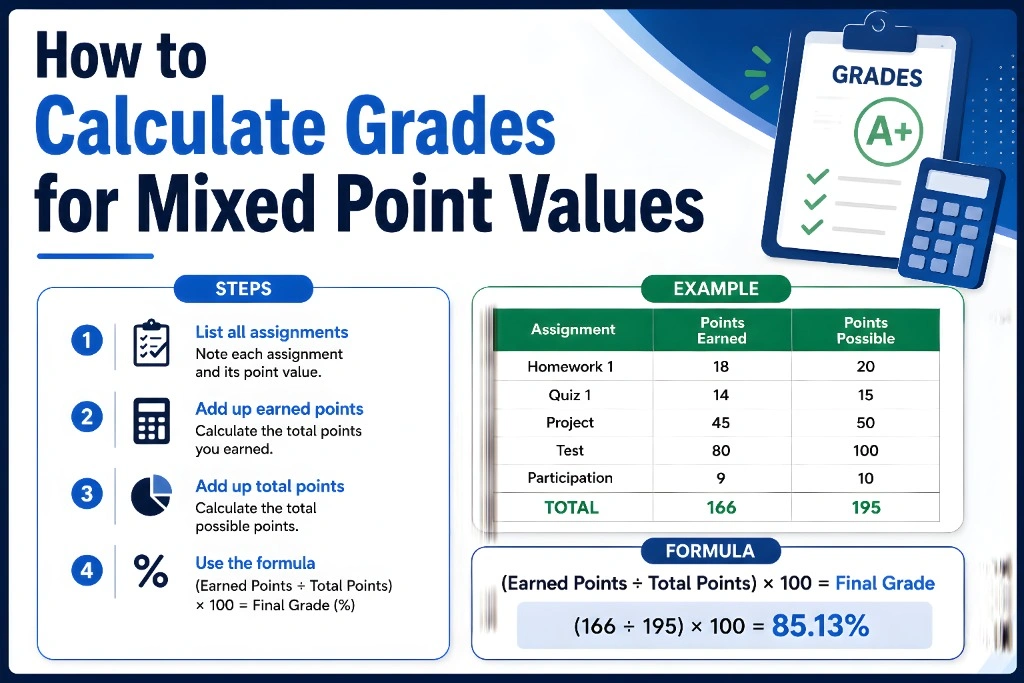
This treats every point equally, no matter where it comes from. You count up all the points a student earned and divide by all the points that were possible.
2. Weighted System
In a weighted system, categories or assignments can count more toward the final grade. For example, a final exam might be worth 40% while homework only counts for 10%.
Easy Step‑by‑Step: Points‑Based Grade Calculation
Step 1 — Add Up All Possible Points
Find the total points possible for every assignment.
Example:
Quiz 1 = 20 points
Project = 100 points
Homework = 15 points
Total possible = 135
Step 2 — Add Up Points Earned
Example:
Quiz: 18
Project: 85
Homework: 13
Total earned = 116
Step 3 — Convert to Percentage
Final grade = (116 ÷ 135) × 100 = 86.0%
Step‑by‑Step: Weighted Grade Calculation
Step 1 — Convert Scores to Percentages
Quiz 1: 18/20 = 90%
Project: 85/100 = 85%
Homework: 13/15 = 86.7%
Step 2 — Multiply by Weight
Quiz: 90 × 0.30 = 27
Project: 85 × 0.50 = 42.5
Homework: 86.7 × 0.20 = 17.34
Step 3 — Add It All Together
Final grade = 27 + 42.5 + 17.34 = 86.84%
Common Mistakes to Avoid
- Don’t mix methods
- Check your weights total 100%
- Convert before multiplying in weighted systems
- Keep extra credit separate
Quick Example You Can Use Today
| Category | Earned | Possible | Weight |
|---|---|---|---|
| Quiz | 18 | 20 | 20% |
| Project | 85 | 100 | 50% |
| Homework | 13 | 15 | 30% |
Final weighted grade = 86.51% You can also read: How to Track Missing Work in Grade Calculations
Tips to Make This Even Easier
FAQS
1. What’s the best method if assignments are very different?
Use a weighted grade system. It lets you value big tasks more than small ones.
2. Can I calculate grades in a spreadsheet?
Yes — spreadsheets are perfect. Use formulas for points, percentages, and weighted scores.
3. Do all grades have to add up to 100%?
Only in a weighted system. In a points‑based system, what matters is total points earned vs total points possible.
4. Should extra credit count as normal points?
Usually not — extra credit should be handled separately so it doesn’t distort the grade scale.
5. What if my teacher uses a rubric instead of points?
Convert rubric scores into percentages before calculating the final grade.
Final Words
Calculating grades for mixed point values doesn’t have to be confusing or stressful. Once you understand the difference between points-based and weighted systems, and follow the step-by-step methods outlined here, you can calculate grades quickly, fairly, and accurately. Using spreadsheets or simple tools can make this process even easier, especially for large classes or multiple assignments. Remember, the goal is consistency and fairness — not complicated math. With these tips, you’ll always have clear and reliable grades that make sense for both you and your students.


